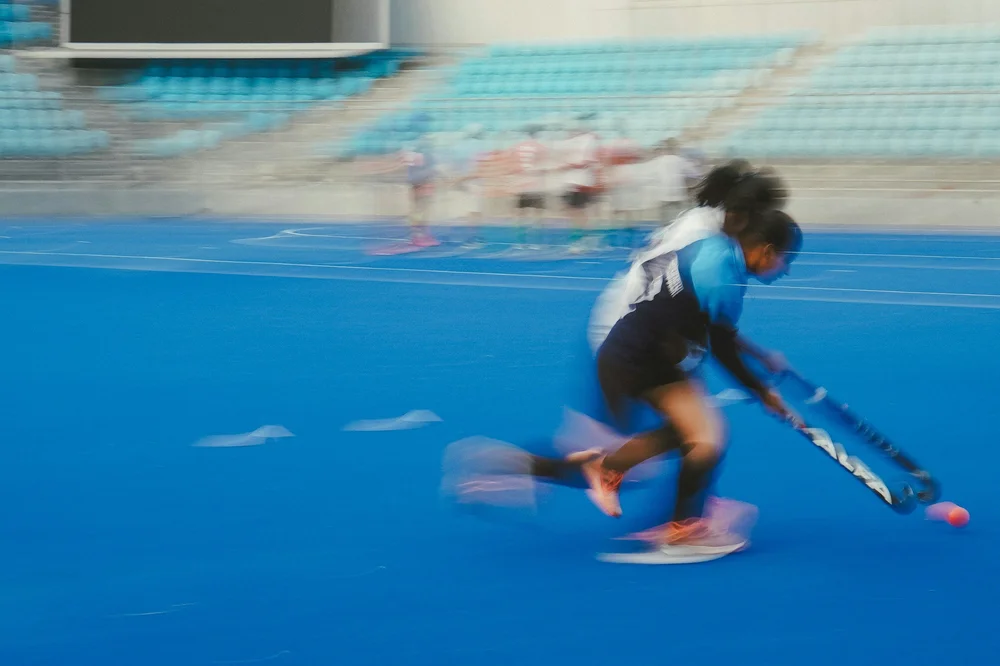
Speed coaching for hockey and netball players in Edinburgh
Hockey and netball are sprint sports played in short bursts — a few metres on court, up to 20 or 30 on the pitch — with a change of direction at the end of almost every one. Yet almost nobody in either sport has ever been coached to sprint. That's the gap we fill, with 1:1 coaching, squad sessions and a plan that fits around the club training you already do.
Book a session Ask a question Coached by Allan Smith: 4× British Champion, GB International and UKA Level 3 coach.Why speed is the missing piece
Club training is built around skills, tactics and fitness. Sprinting tends to be treated as something you either have or you don't. But acceleration — the first five to ten metres — is a skill, and like any skill it improves with coaching. Most hockey and netball players have never been taught how to start, how to accelerate or how to stop. Fix those three things and you're quicker in every phase of the game, without needing to be any fitter.
First-step quickness
Winning the ball. Making the intercept. Getting free from your marker.
Acceleration over 5–20m
The distances your sport is actually played at.
Repeat sprint ability
Holding your speed in the fourth quarter.
Deceleration & turns
Faster, safer changes of direction and landings.
Who this is for
- School and club hockey players — outfield players and goalkeepers
- Netball players at school, uni and club level — every position, especially C, WA and WD
- Players preparing for trials, performance programmes or a step up a league
- Juniors aged 8–15 — through our weekly Speed School
- Clubs and coaches who want a speed block for their squad
Speed coaching for hockey players
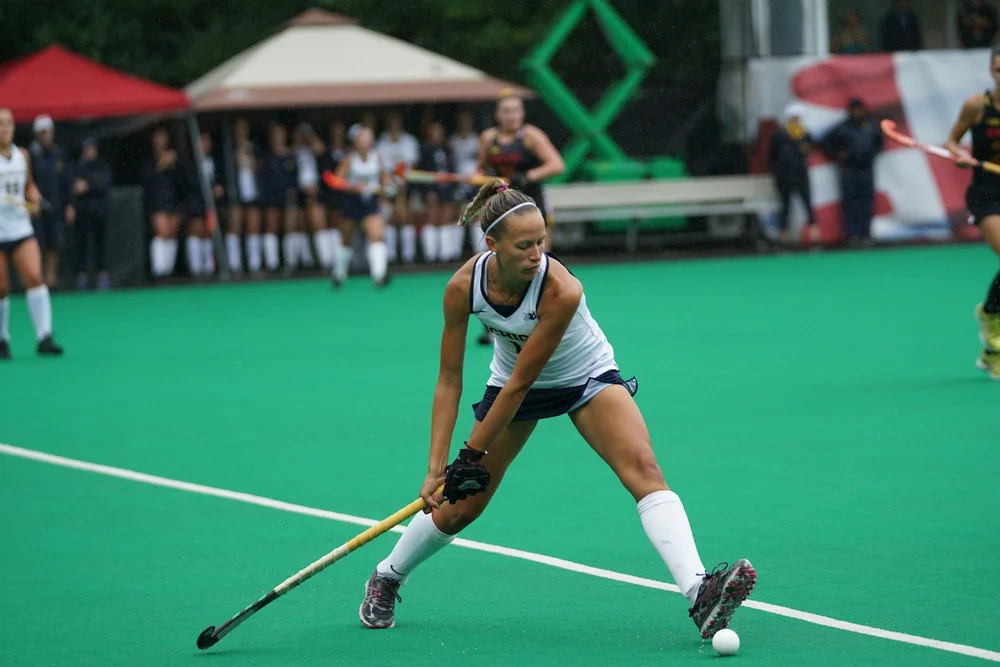
In hockey, the difference between winning the ball and chasing it is usually a single stride. Players make dozens of short, flat-out efforts across four quarters — leading, pressing, tracking back — and most of them start from a low, bent-over position with a stick in your hands. That makes hockey sprinting its own skill, and it's what we coach.
What makes hockey speed different
Sprinting with a stick
Two hands on the stick takes away much of the arm drive sprinters rely on. We teach you to generate speed from your legs and body position — and when to come off the stick hand and run properly.
Accelerating low
You receive, tackle and break in a crouched position. We build the posture and strength to accelerate low without losing power or balance.
With and without the ball
Carrying the ball changes your stride. We train both: open running off the ball, and accelerating with it on your stick.
Repeat efforts on a big pitch
Rolling subs mean you're expected to go flat out every time you're on. Repeat sprint ability decides whether your last sprint is as quick as your first.
By position
Leading and pressing
Leading to get free, breaking into the D and pressing defenders high up the pitch.
Focus: first-step quickness, curved runs, getting goal-sideBox to box
The most repeat sprints on the pitch, covering transition in both directions.
Focus: repeat sprint ability, accelerating from a moving startRecovery runs
Tracking runners, turning to chase and closing down the D.
Focus: turn-and-go acceleration, decelerating into a tackle positionExplosive off the line
Rushing out at 1v1s and shoot-outs, pushing off laterally and getting back up and set.
Focus: first-step power, lateral push-off, recovering to your feetYour first three steps decide the corner
The first runner has to explode off the backline the instant the ball is injected — and the first three steps decide whether you close the shot down or watch it fly past. We drill reaction starts and first-step acceleration from the exact start position you use on the backline.
Train at Peffermill — the home of Edinburgh hockey
Peffermill Playing Fields is Scotland's National Hockey Academy. Its two floodlit water-based pitches are home to Edinburgh University's hockey clubs, the training base for the Scotland squads, and a training and match venue for local club teams.
It also has a synthetic sprint track on the same site — so you can work on your speed a few metres from where you play.
- Already train at Peffermill? Book your speed session just before club training. You sprint on fresh legs, then walk across to the pitch already warmed up.
- Junior hockey players aged 8–15 can join Speed School at Peffermill every Monday at 6pm, October to March.
- Choose it when you book. Peffermill is one of our training locations — just select it on the booking form.
- Address
- 42 Peffermill Road, Edinburgh EH16 5LL
- On site
- Water-based hockey pitches, synthetic sprint track, changing pavilions
- By bus
- Lothian Buses 2, 14, 21, 30 and 42 stop nearby
- Parking
- On-site, but it fills up at peak times — car-share or get the bus
Fitting speed work around club hockey
Most club players already train twice a week and play on a Saturday. You don't need to add a lot — you need to add the right thing at the right time. Speed sessions are short sprints with full recovery, so they don't wear you out the way a conditioning session does. What matters is when you do them. Here's how a typical in-season week fits together:
- MonSpeed sessionFresh legs, 48 hours after the match
- TueClub trainingSkills and tactics
- WedGym or restStrength work, if you do it
- ThuClub trainingMatch preparation
- FriRestLegs fresh for Saturday
- SatMatchLeague game
- SunRecoveryWalk, mobility, rest
Club trains on a Monday? Do your speed session first on the same evening — at Peffermill, that means sprinting on the track and then walking straight onto the pitch. Or move it to Tuesday. The only fixed rule is at least 48 hours between your speed session and your next match.
Speed coaching for netball players
Netball is played in a small space — a court around 30 metres long, split into thirds — so speed is decided in the first two or three steps. The footwork rule means you can't run with the ball: you have to create your speed before you receive it, then stop dead on landing. Getting free from a marker, driving onto a pass and landing under control are all speed skills, and they're all coachable.
What makes netball speed different
Getting free
Dodges, double-dodges and drives — beating your marker with a change of pace and direction in a tiny space. We train the sharp cut and the explosive step out of it.
Quick from standing
Most efforts start from a balanced, near-stationary stance — forwards, sideways or backwards. We train you to move fast in any direction from a standing start.
Stopping dead
The footwork rule makes braking non-negotiable. We coach landing and deceleration so you stop faster, stay balanced and are ready to pass.
Landing and knees
Jumping and sudden stops put real load through the knees. Good landing and deceleration technique is one of the most valuable things you can train to stay on court.
By position
The engine
Covers more court than anyone and drives on every centre pass.
Focus: repeat sprint ability, staying sharp in the fourth quarterDrive and deny
Explosive drives onto the centre pass and the circle edge — or shadowing the player making them.
Focus: first-step speed, beating or tracking a marker, braking on the circle edgeTwo thirds of court
Working through court and into the circle, with constant changes of direction.
Focus: change of direction, short acceleration, landing controlExplosive in the circle
Short, sharp movement in a tight space — holding, repositioning and jumping.
Focus: first-step power, lateral movement, take-off and landingIndoors at Meadowbank, or at your club
Meadowbank Sports Centre has indoor training space, so 1:1 netball sessions run whatever the Edinburgh weather is doing. For squads, we can come to your own venue and run speed work as part of your normal training night.
Fitting speed work around club netball
Netball leagues often play midweek, which frees up the weekend — the ideal slot for a speed session. Here's an example week with a Wednesday league match:
- MonClub trainingSkills and match play
- TueRest or gymKeep it light
- WedMatchLeague night
- ThuRecoveryLight movement
- FriRestOr school sport
- SatSpeed session3 days after the match, 4 before the next
- SunRestFull recovery
League on a different night? Keep the same rule: at least 48 hours between your speed session and your next match, and never sprint on tired legs.
How we fit speed around your existing training
You already have club training, matches and maybe the gym or school sport. Speed work should make all of that better, not compete with it. These are the rules we plan around:
- Keep 48 hours between speed and your next match. Sprinting is demanding on your nervous system, and you want to arrive at matches fresh.
- Sprint fresh. On a day with club training or the gym, do speed first. Sprinting on tired legs trains you to be slower and puts your hamstrings at risk.
- Don't stack hard days. Avoid putting a speed session the day after a heavy conditioning session or a tough match.
- One session a week is enough in season. Short, high-quality sprints with full recovery keep you improving without adding fatigue.
- Tell your club coach. Let them know what you're working on, so their conditioning and your speed work don't pile into the same week.
- Tell us your schedule. Share your training nights and match days at your first session and we'll plan around them.
Plan your season
Off-season
2 sessions a weekNo matches to recover from, so this is the time to rebuild sprint mechanics and lift your top-end speed.
Pre-season
1–2 sessions a weekSharpen acceleration, repeat sprints and change of direction so you're quick from the first league game.
In-season
1 session a weekLow volume, high quality. Keep getting quicker without taking anything away from match day.
Breaks
A short speed blockUse any break in the season — hockey's indoor season, a netball league break, school holidays — for a focused block of speed work.
What a session looks like
Assessment
Your first session includes a full movement and technique assessment, so we know exactly what's holding your speed back.
Movement prep
A warm-up that doubles as technique work — posture, foot contact and arm action.
Acceleration
Sprint work over the distances your sport is played at, with full recovery between reps so every one is high quality.
Into your sport
Transferring it to the game — with stick and ball for hockey; reactive starts, dodges and landings for netball.
Want a benchmark first? See how your 10m and 20m times compare with our sprint standards by age.
Club and squad sessions
We run group speed sessions for hockey and netball clubs, at your venue and in your normal training slot. A whole squad learning to start, accelerate and stop properly is one of the quickest wins a team can make.
Speed workshop
One session that teaches your squad the fundamentals of acceleration and deceleration, with drills your coaches can keep using at training.
Pre-season block
A series of sessions before the league starts, building acceleration and repeat sprint ability for the first game.
In-season top-ups
Short speed sessions at the start of your training night, keeping players sharp without adding fatigue.
1:1 coaching. Group sessions at your club's venue — ask for team rates.
Ages 8–15, every Monday at 6pm. Peffermill from October to March, The Meadows from April to September.
Frequently asked questions
Isn't speed just genetic?
Top speed has a genetic ceiling; acceleration over 10 metres is overwhelmingly technical — and that's the part that matters in your sport.
What age can players start?
Ages 8–15 can join Speed School; 15+ and adults train 1:1 or in squad sessions.
Will speed sessions leave me tired for club training and matches?
Not if they're planned properly. Speed work is short sprints with full recovery, so it's far less tiring than a conditioning session. We keep at least 48 hours between your speed session and your next match, and plan around your club training nights.
How often should I do speed training?
In season, one session a week is enough to keep improving without adding fatigue. In the off-season and pre-season, two a week builds speed faster.
I already train four or five times a week. Is there room for this?
Usually, yes. One short speed session a week is enough in season. Tell us your weekly schedule and we'll find the slot that adds the most without overloading you.
Can I train at Peffermill?
Yes. Peffermill is one of our training locations — select it when you book. It's also where Speed School runs on Monday evenings from October to March.
I'm a hockey goalkeeper. Is this for me?
Yes. Keepers need explosive first steps, powerful lateral push-offs and the ability to get up and set quickly, and all of that is trainable. We adapt the work to your position.
Can netball sessions be indoors?
Yes. Meadowbank Sports Centre has indoor training space, so sessions run whatever the weather.
Will speed training reduce my injury risk?
No one can promise that, but good sprint mechanics, controlled deceleration and landing, and regular, well-planned sprint work all help keep hamstrings and knees healthy. It's built into every session.
Do you coach whole teams?
Yes. We run group speed sessions for hockey and netball clubs at your venue. Get in touch for team rates.
Individual or whole-squad coaching
1:1 at Meadowbank, Peffermill or another location that suits you, or group sessions at your club.
Book a session Ask a question