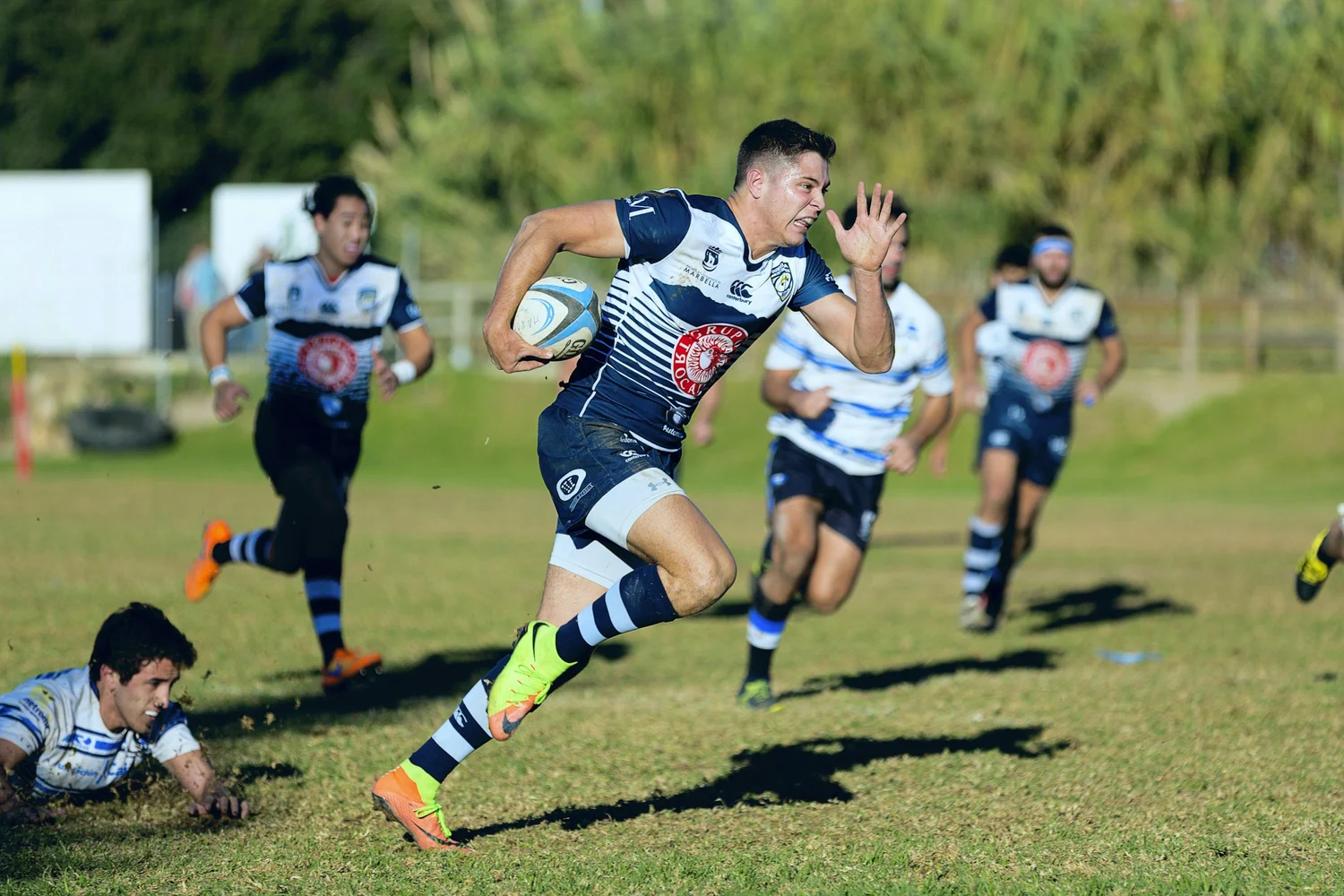
Rugby sprint times by age
How fast should a rugby player be at 13, 15, 17 or in the senior game? Separate 10m, 20m and 40m benchmarks for backs and forwards — because a prop and a winger shouldn't be measured against the same clock.
Book a timed speed session Rugby speed coaching Written by Allan Smith, head coach at Edinburgh Sprint Coach: 4× British Champion, GB International and UKA Level 3 coach.The short answer
At 16–18, academy-level backs run 40m in about 5.30–5.48 seconds and forwards in 5.50–5.72s. Over 10m the gap is smaller: 1.74–1.81s for backs and 1.80–1.88s for forwards. Published testing of English regional academy players put the U18 average at 1.81s for 10m, 3.09s for 20m and 5.51s for 40m, with backs and forwards combined.
Averages from Darrall-Jones, Jones & Till (2015), regional academy players, timing gates, standing start 0.5m behind the first gate.
Rugby sprint times by age: backs and forwards
Choose backs or forwards, then find the player's age. Each table shows four bands — the gold column is elite for that age and position group.
Backs — 10m sprint
Seconds · electronic timing| Age | Developing | Good school & club | Academy level | Elite |
|---|---|---|---|---|
| 12–13U13 / U14 | 2.17+ | 2.03–2.16 | 1.92–2.02 | Under 1.92 |
| 14–15U15 / U16 | 2.01+ | 1.89–2.00 | 1.80–1.88 | Under 1.80 |
| 16–18U17 / U18 | 1.94+ | 1.82–1.93 | 1.74–1.81 | Under 1.74 |
| Senior18+ | 1.88+ | 1.76–1.87 | 1.68–1.75 | Under 1.68 |
10m is power off the line: the first steps at the breakdown, in defence and on the carry.
Backs — 20m sprint
Seconds · electronic timing| Age | Developing | Good school & club | Academy level | Elite |
|---|---|---|---|---|
| 12–13U13 / U14 | 3.77+ | 3.53–3.76 | 3.38–3.52 | Under 3.38 |
| 14–15U15 / U16 | 3.43+ | 3.23–3.42 | 3.10–3.22 | Under 3.10 |
| 16–18U17 / U18 | 3.30+ | 3.10–3.29 | 3.00–3.09 | Under 3.00 |
| Senior18+ | 3.21+ | 3.01–3.20 | 2.92–3.00 | Under 2.92 |
20m covers acceleration into space and the line speed a defence needs.
Backs — 40m sprint
Seconds · electronic timing| Age | Developing | Good school & club | Academy level | Elite |
|---|---|---|---|---|
| 12–13U13 / U14 | 6.81+ | 6.36–6.80 | 6.05–6.35 | Under 6.05 |
| 14–15U15 / U16 | 6.21+ | 5.81–6.20 | 5.55–5.80 | Under 5.55 |
| 16–18U17 / U18 | 5.89+ | 5.49–5.88 | 5.30–5.48 | Under 5.30 |
| Senior18+ | 5.69+ | 5.29–5.68 | 5.10–5.28 | Under 5.10 |
40m is the classic rugby speed test and the best measure of open-field pace.
Forwards — 10m sprint
Seconds · electronic timing| Age | Developing | Good school & club | Academy level | Elite |
|---|---|---|---|---|
| 12–13U13 / U14 | 2.25+ | 2.11–2.24 | 1.98–2.10 | Under 1.98 |
| 14–15U15 / U16 | 2.07+ | 1.95–2.06 | 1.85–1.94 | Under 1.85 |
| 16–18U17 / U18 | 2.01+ | 1.89–2.00 | 1.80–1.88 | Under 1.80 |
| Senior18+ | 1.95+ | 1.83–1.94 | 1.74–1.82 | Under 1.74 |
10m is power off the line: the first steps at the breakdown, in defence and on the carry.
Forwards — 20m sprint
Seconds · electronic timing| Age | Developing | Good school & club | Academy level | Elite |
|---|---|---|---|---|
| 12–13U13 / U14 | 3.90+ | 3.66–3.89 | 3.48–3.65 | Under 3.48 |
| 14–15U15 / U16 | 3.53+ | 3.33–3.52 | 3.18–3.32 | Under 3.18 |
| 16–18U17 / U18 | 3.41+ | 3.21–3.40 | 3.10–3.20 | Under 3.10 |
| Senior18+ | 3.33+ | 3.13–3.32 | 3.02–3.12 | Under 3.02 |
20m covers acceleration into space and the line speed a defence needs.
Forwards — 40m sprint
Seconds · electronic timing| Age | Developing | Good school & club | Academy level | Elite |
|---|---|---|---|---|
| 12–13U13 / U14 | 7.11+ | 6.66–7.10 | 6.30–6.65 | Under 6.30 |
| 14–15U15 / U16 | 6.46+ | 6.06–6.45 | 5.75–6.05 | Under 5.75 |
| 16–18U17 / U18 | 6.13+ | 5.73–6.12 | 5.50–5.72 | Under 5.50 |
| Senior18+ | 5.93+ | 5.53–5.92 | 5.30–5.52 | Under 5.30 |
40m is the classic rugby speed test and the best measure of open-field pace.
Girls' and women's rugby: these tables are for boys and men. For female players, use the girls' bands on our sprint time standards by age page — the same backs-versus-forwards pattern applies.
What each band means
The bands are based on published testing of UK academy and school players. They assume electronic timing gates, a standing start 0.5m behind the first gate and the best of three runs. The senior row covers adult players: the academy column there is the typical range for professional and semi-professional squads.
For general sprint standards for any sport, see our sprint time standards by age, or put your exact time into the sprint standards calculator.
Which sprint matters most in your position
Backs and forwards is the first split, but every position has its own speed profile. Train and test the distance your position is played at.
Power in the first five metres
Props and hookers rarely sprint far, but they need to get off the line, hit rucks and carry with momentum.
Key distance: 5–10mAcceleration, again and again
Restarts, lineout chases and getting round the corner to the next ruck — repeated efforts with little rest.
Key distance: 10–20mFirst to the breakdown
Support lines, jackaling and defensive line speed. The quickest forwards on the pitch.
Key distance: 10–30mSharpest first step
Reacting to the ball, sniping round the fringes and covering behind the line.
Key distance: 5–10m, reactiveAcceleration into space
Taking the ball flat, attacking a gap and getting through contact before the defence closes.
Key distance: 10–30mOpen-field speed
Wingers and full-backs need the most top-end pace: finishing breaks, kick chases and covering tries.
Key distance: 30–40m+Why rugby isn't just about the fastest time
In rugby, speed collides with mass. Momentum — body mass multiplied by speed — decides who wins contact, and it's why a heavy forward with a decent 10m can be more effective than a lighter player with a faster one.
Players get heavier and stay quick
In English academy testing, momentum over 5–10m rose by around 15% from U16 to U18 and by another 15% to U21, as players added mass without losing speed.
10m rarely separates players
One study comparing U18 academy and school players found little difference over 10m. The academy players pulled away over 20m and 40m — top-end speed is what sets them apart.
Don't bulk up slowly
Adding size is only useful if speed holds. Strength and speed should be trained together, and sprint times re-tested as body weight changes.
What rugby academies test
Academy and pathway testing days vary, but most include some combination of:
- Linear sprints — 10m, 20m and 40m on timing gates.
- Body mass and momentum — sprint speed is often combined with body weight to calculate momentum.
- Strength and power — jumps, and for older players, gym-based strength tests.
- Fitness — an intermittent running test such as the Yo-Yo or the 30-15.
Preparing for a pathway trial or testing day? Our rugby academy preparation programme builds the acceleration and top speed that testing days measure.
How to time a rugby player's 10m, 20m and 40m
Test the same way every time, so the numbers are worth comparing:
Warm up properly
Ten minutes of jogging, mobility and drills, then two or three build-up runs. Never test cold.
Standing start
Front foot 0.5m behind the start line in a split stance. No three-point start and no rolling in.
Mark every split
Tape-measure 10, 20 and 40m. Gates or cones at each split time all three distances in one run.
Best of three
Full recovery between runs — at least three minutes for 40m. Record the best time at each split.
Same conditions
Boots on grass or 3G will be slower than spikes or trainers on a track. Note the surface and re-test on the same one.
Stopwatch times usually read quicker than timing gates, often by a tenth of a second or more. If you're hand-timing, treat a time close to a band boundary as the band below.
How rugby players get faster
Rugby players are usually strong but rarely coached to sprint. Turning that strength into speed is where the quickest gains come from.
Acceleration technique
Body angle, shin position and pushing back into the ground. Most players lose a tenth in the first three steps.
Strength into speed
Heavy sled pushes and resisted sprints turn gym strength into force on the ground.
Accelerating into contact
Staying low and driving through the last steps before contact, so you hit the line at speed.
Top-end speed
Posture, foot strike and relaxed arm action — essential for the back three.
Repeat sprints
Holding your speed into the last ten minutes, when tired defences leave space.
Speed work fits around club and school rugby with one or two short sessions a week, kept at least 48 hours from match day. Summer pre-season is the best time for a focused speed block. See our rugby speed coaching page for how we plan it.
Get timed — then get faster
Every first session includes a full movement and technique assessment. We time every athlete, so you'll know exactly which band you're in and what to work on.
Meadowbank Sports Centre, or another Edinburgh location that suits you.
Ages 8–15, every Monday at 6pm. The Meadows in summer, Peffermill in winter.
More speed standards and guides
Rugby sprint times: common questions
What is a good 40m time for a rugby player?
For players aged 16–18, around 5.30–5.48 seconds is academy level for backs and 5.50–5.72s for forwards. Senior professional backs are typically around 5.10–5.28s. Times are electronic, from a standing start 0.5m behind the line.
What is a good 10m sprint time for a 16-year-old rugby player?
At 16–18, 1.74–1.81 seconds is academy level for backs and 1.80–1.88s for forwards. Published testing of English regional academy players put the U18 average at 1.81s.
How much faster are backs than forwards?
Usually only a few hundredths of a second over 10m, growing to around two tenths over 40m. Forwards carry more mass, so they win on momentum rather than top speed.
What do rugby academies test?
Most testing days include 10m, 20m and 40m sprints on timing gates, body mass and momentum, jump or strength tests, and an intermittent fitness test such as the Yo-Yo or the 30-15.
Why are school and academy players similar over 10m?
Research comparing U18 academy and school players found little difference over 10m, but academy players were clearly faster over 20m and 40m. Top-end speed is what separates them, so it's worth training as well as acceleration.
Is speed or size more important in rugby?
Both, which is why academies look at momentum: body mass multiplied by speed. Adding size only helps if speed holds, so strength and sprint training should go together.
How should I time a rugby player's 40m?
Warm up, start from a standing split stance 0.5m behind the line, and time 10m, 20m and 40m splits on gates if possible. Take the best of three runs with full recovery and re-test on the same surface.
Do you have sprint standards for girls' and women's rugby?
These tables are for boys and men. For female players, use the girls' bands on our sprint time standards by age page. The same pattern applies, with backs typically quicker than forwards.
Want to be the quickest in your position?
Book a session and we'll time your 10m, 20m and 40m, show you what's slowing you down, and plan your speed work around your rugby.
Book a session Ask a question